If you want people to develop an interest in a SaaS tool, you must learn to write SOLID software reviews.
By solid, I mean reviews optimized for conversion. Content that can:
- Pull in noteworthy traffic,
- Make people care,
- And increase sign up.
There are two ways to create high-converting software comparison reviews.
- Using opinions
- Or relying on facts.
In this article, I’ll PAIR factual and opinion-based software reviews together.
The idea is to show how each compares so you can know which converts best and WHY.
Let’s dive in.🙂
What is a factual software review?
A factual software review is an informational piece backed by concrete evidence that’s observable and verifiable.
Some typical examples include:
These reviews contain proven truths that cannot be disputed.
They’re defined and measurable and can be proven to be true or false through objective evidence.
They don’t contain ideas readers can argue against.
They’re the same for everyone and cannot be interpreted otherwise.
The gist is factual reviews rely strongly on denotative languages. So, the writer’s feelings and ideas barely hold water here.
Why are factual reviews important?
Factual software reviews are important because:
- They make it easy for a SaaS brand to go toe to toe with the competition.
- They give readers a clear, unbiased view of the better software for specific use cases.
Overall, a well-written factual review gives readers a broad overview of the software. There’s no logic (or faux logic) here; the writer simply states what is the way it is.
Pros of a factual software review
- Converts well when written for the SaaS brand by the SaaS brand.
- It helps new SaaS carve a market for themselves.
- Bias are easily identified and flushed out.
- Easy to create with AI prompts.
- Does not require heavy research.
Cons of a factual software review
- It’s not the best content format for affiliate marketers or influencers.
- Can easily lead to bland, generic content users won’t read.
When to write a factual software review
Recommended if
- You own and manage the software.
- You’re a B2B writer.
- You’re building a comparative landing page.
- You’re writing an X vs. Y article.
- You’re trying to reach a broad audience.
Not recommended if:
- You want to share personal opinions.
- Your SaaS isn’t as good as the competition.
What is an Opinion-based Software Review?
An opinion-based review is a writer’s spin or an author’s honest opinion of why the software is useful or useless.
Some typical examples include:
- Backlinko’s Ahref review.
- Onely’s SEO content editor reviews.
- DDIY Writersonic review.
These reviews express feelings, an attitude, a value judgment, or a contrarian view.
They sit on both sides of the moral divide.
They can be neither true nor false. Or feel true for some and false for others.
The gist is that opinion-based reviews rely strongly on connotative languages. So it can mean different things to different people. And there’s room for argument. 🙂
Why Are Opinion-based Software Reviews Important?
Opinion-based software reviews are important because:
- They create room for SaaS writers to connect with readers empathically.
- They allow writers to take a conventional claim and put a spin on it.
Overall, a good opinion-based review makes readers see a SaaS tool from a very specific, sympathetic point of view. And by this logic (or faux logic) renders all other points of view and all competing products moot and impotent.
It’s a powerful way to make people love a SaaS tool.
Pros of an opinion-based review
- Best content format for affiliate marketers & influencers.
- Excellent content strategy for positioning a SaaS brand as thought-leaders.
- Supports a higher degree of freedom when making arguments.
- Can easily hold compelling claims as to why a feature is important.
Cons of an opinion-based review
- Requires heavy research.
- Susceptible to bias, but not always bias.
When to write an opinion-based software review
Recommended If
- You’re an affiliate marketer, influencer, or enthusiastic user.
- You want to share fresh findings about the software.
- Your SaaS is not as advanced as the competition.
- You want users to see your software in a new light.
- You’re targeting a niche market.
Not recommended if
- You don’t have new ideas or fresh perspectives to share.
- You’re not a power user of the software.
Factual Vs. Opinion-based Software Reviews at a Glance
| Opinion-based Software Reviews | Factual Software Reviews |
| Opinion-based reviews thrive on new ideas. Fresh perspectives. | Factual reviews thrive on defined and measurable ideas. |
| Requires rigorous research and intuitive opinions. | Easy to create with AI tools. |
| Converts best as single software reviews. | Converts best as X vs. Y articles and comparative landing pages. |
| Requires long-term experience with the tool. | Requires copywriting skills. |
| Best for affiliate marketers and influencers. | Best for SaaS brands and B2B writers. |
| Can easily influence an ultra-specific audience (niche market). | Can easily influence a broad audience. |
Factual Vs. Opinion-based Software Reviews: Blow by Blow Analysis
On Tone-of-Voice
Tone of voice (TOV) reflects the intent behind your words—the reason a writer writes the way they write.
It shows how you:
- Make arguments
- Get your points across
- Talk with readers, etc.
The gist is that TOV tells you how best to say what you want to say.
With that in mind, let’s see how factual and opinion-based reviews compare in terms of TOV.
Opinion-based reviews read like this:
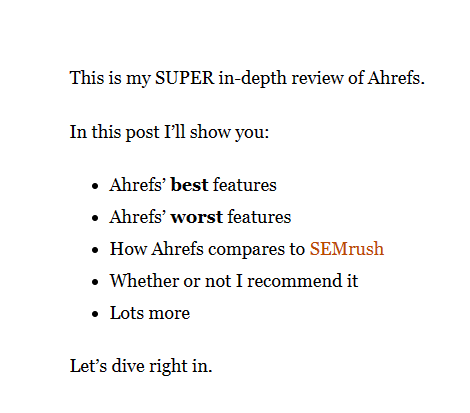
The writers state from the get-go that they will be sharing their thoughts.
So yeah, you’ll find them talking about their experience with the tool more often than not.
(And you’ll easily find the subject pronoun “I” spread across the content.)
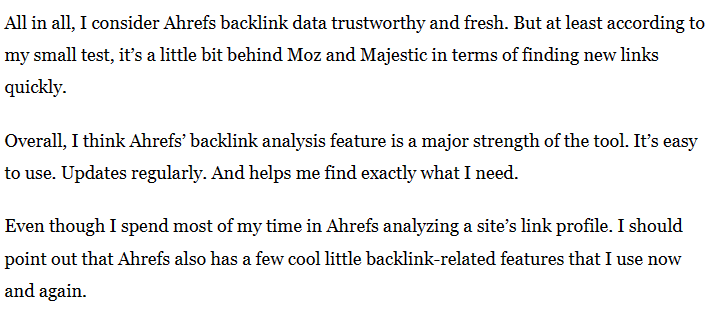
Although this can easily lead to bias. Which, sadly, is not always possible to eliminate. 😶
Factual reviews, on the other hand, read like this:
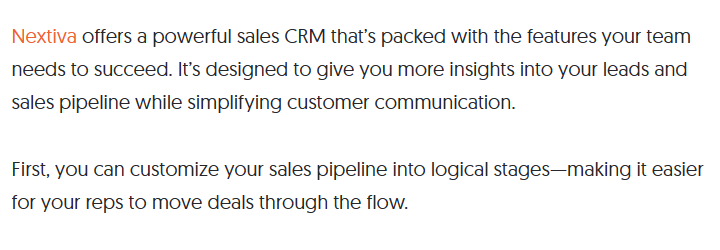
There is this “YOU” perspective about factual reviews.
You’ll find the writers telling YOU how useful the tool can be to YOU.
Or why YOUR team needs the software.
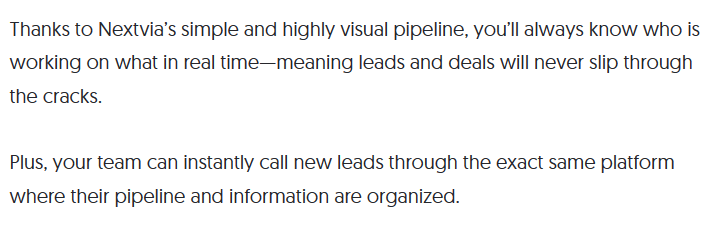
The good thing about writing factual reviews is that you don’t need long-term, real-life experience using the tool for your TOV and viewpoints to sound authentic.
Though not having long-term experience can be a bad thing if you fail to do thorough research.
Also, know it’s okay to use a sales-y tone for factual reviews, especially if you’re trying to score points off the competition.
On a final note,
The tone of voice debate between factual and opinion-based reviews does not entirely revolve around pronouns like “I” and “You.”
PERSPECTIVE also matters.
- Are you writing as someone with IN-DEPTH EXPERIENCE using the software? Go with opinion-based reviews.
- Or are you a SaaS writer with LIMITED TIME to research but need to come up with thumb-stopping ideas about the software? Factual reviews will suit you better.
On Target Audience
Every reader wants something dedicated to them. A review genuinely written with their best interests at heart.
That’s why, at the top of every writing brief, I explicitly state my target audience: the exact people I’m writing for.
Now, you can write a factual or opinion-based review to anyone and everyone.
There are no age, demographic, or socioeconomic restraints.
But it will be genuinely helpful to know which converts best across audiences.
- Which readers will prefer undiluted facts?
- And in what case would your audience want opinion-based articles?
Well, let’s look at a few case studies.
I’ll start with a factual review from Copy.ai.
In this comparison review, Jaspar had accusedly spread false narratives about their benefits compared to Copy.ai.
To combat this narrative, Copy.ai began its review like this:
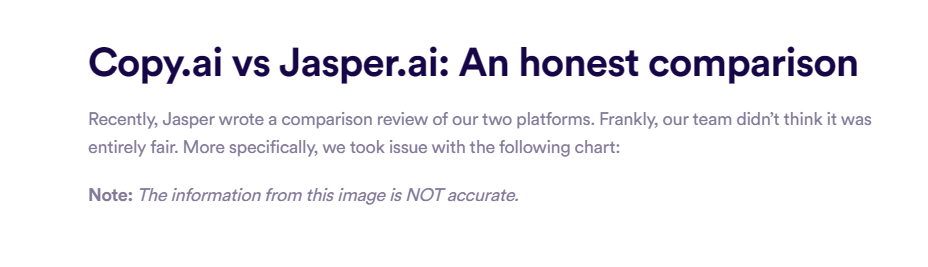
In very clear terms, Copy.ai made readers know that their comparative article is a product of Jasper’s false claims.
Right off the bat, this showed that Copy.ai doesn’t appreciate biased ideas and would like to address folks who have:
- Been influenced by Jaspar’s narratives
- People new to AI
- Users looking for the better tool between the two
- And individuals in need of clear, differentiating information.
At a glance, Copy.ai, by creating a factual X vs. Y article, could efficiently address a vast and otherwise over-saturated audience in an ultra-specific way.
Moving to opinion-based articles.
People look for opinions when they’re having a hard time arriving at a decision.
And they look for it from folks with experience. Or at least someone they trust.
For example,
I was looking for the best CRM for realtors, so I searched Google. All the top-ranking articles had titles like Best CRM for Realtors 2023.
I clicked on a few but wasn’t satisfied with the info I was getting. I needed something ultra-specific.
After a little more research, I stumbled upon a SoftGist article on why realtors might have a good time using Pipedrive CRM.
Here’s an overview of the intro:
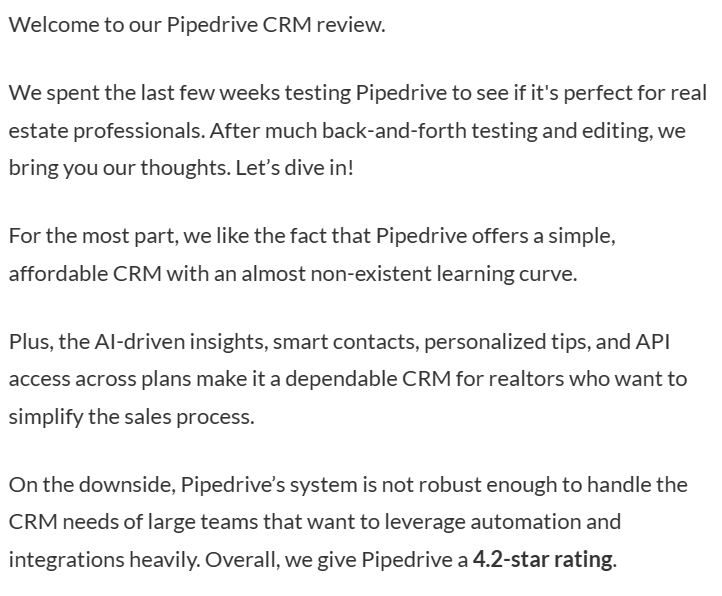
(Note that the proverbial “I” in opinion-based reviews is replaced with “We” here, yet the personal opinions shine.)
You see, what made me fall in love with this review was that:
Unlike most other articles on the web, this one focused on how a specific tool is built to help my real estate business scale.
The intent and audience were ultra-specific.
So yes, after reading through, I took SoftGist’s opinion at face value and went with Pipedrive.
For the most part,
SaaS content writers trying to position a brand as best-in-class to a BROAD audience will thrive with factual articles like Copy.ai wrote.
At least, in such factual articles, they can easily make their words matter to people from different backgrounds.
On the other hand, Softgist’s review served an ultra-specific niche (realtors), which made it easy to share ideas a SEGMENT of the market will find helpful.
So yeah, affiliate marketers and influencers targeting a small but potent audience will have a better time writing opinion-based reviews.
On Story Telling
Storytelling is the backbone of good writing, even in SaaS.
For example, see how this opinion-based review begins with a simple yet solid story (at least in miniature).
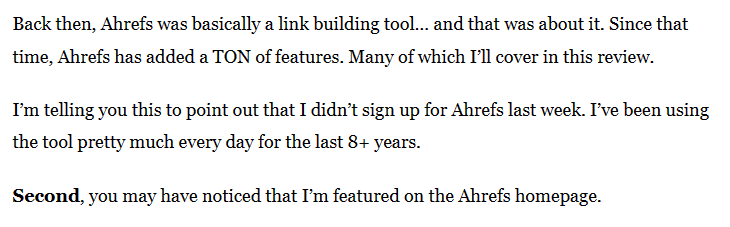
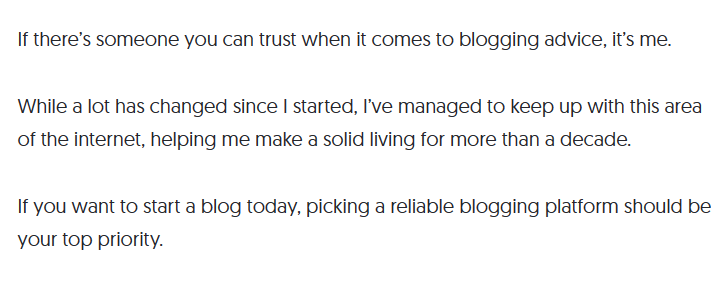
And thankfully, storytelling is not limited to opinion-based reviews; factual review writers also get a say here.
Overall,
Storytelling is not limited to any review type.
In fact, when you use stories in miniature—whether in factual or opinion-based reviews—readers get the impression your article is credible and unbiased.
So yeah, use stories sparingly across reviews. This one is a toss-up.
On Empathy
Empathically connecting with readers is a sure-fire way to make sales happen.
The thing is, once a reader begins to care about the words you write, they stop reading your SaaS reviews from a sleazy-marketer-wants-my-money perspective and, instead, focus on your core message.
Alright, how do opinion-based and factual reviews compare on this ground?
Well, on a scale of 1/10, opinion reviews connect empathically with readers 8/10.
Factual reviews, not so much. Probably a 5.5, or at best, 6/10.
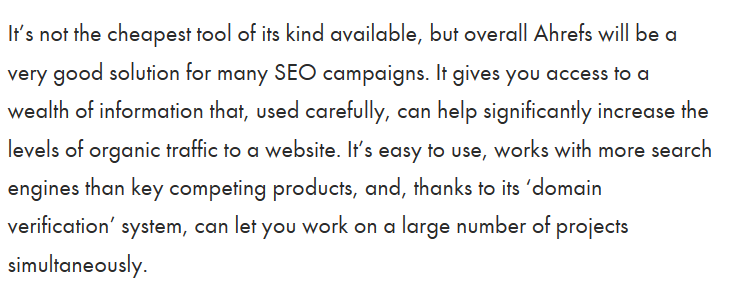
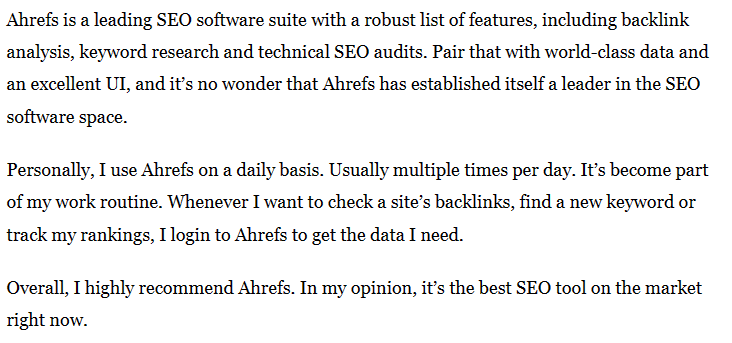
For example, here’s a conclusion from two high-ranking Achref reviews.
The FACTUAL one.
And the OPINION-BASED one.
Look at the factual review, and you’ll find sentences like
- It’s not the cheapest tool of its kind.
- It gives access to a wealth of information.
- It’s easy to use, etc.
It was more direct and straight to the point, sharing no real-life experience or emotional attachment to the tool.
However, the opinion-based review conveyed ideas differently. A close look and you’ll find sentences like:
- Personally, I use Achref on a daily basis.
- I log in to Achref to get the data I need.
- Overall, I highly recommend Achref, etc.
The way the writer talks about their personal experience breeds empathy, making readers care and more compelled to use the tool.
From my experience,
Opinion-based reviews are more emotionally compelling than factual reviews.
At least, it allows readers to better understand how the writer came to their conclusion.
However, drawing the line between what’s biased and honest when writing an opinion-based piece can place you between a rock and a hard place. Thread wisely!
Factual Vs. Opinion-based Software Reviews: Which Convert’s Better?
Well, it depends on WHO’s writing and the INTENT behind the copy.
For context:
- Opinion-based reviews will convert better if you’re an affiliate marketer or influencer trying to recommend a SaaS product to your audience.
- But if you’re a SaaS writer or brand trying to position your SaaS tool as a force to be reckoned with in a saturated market, go with factual reviews.
Overall, factual and opinion-based software reviews are powerful lead magnets anyone can use to make people care about a SaaS product.
You just need to know how to create high-converting ones.
Conclusion
Spotting the difference between factual and opinion-based writing is not always easy. It took me years of writing and rewriting to untangle these points.
Well, I’m hoping it won’t take you that long.
Because, indeed, the above points are in no way exhaustive.
They’re simply starting points for SaaS content writers with an eye for conversion.
For one, they helped me gain first-hand insight into what’s working and what’s not.
Either way, I hope you had a good read. 😉 Cheers!
Got questions?
Can I create a mix of opinion-based reviews and factual content?
YES, you can. In truth, most of the ideas shared in opinion-based reviews are obvious facts demystified. But be careful when writing factual reviews for a SaaS brand. You see, the line between opinions and facts is thin. Unknowingly bridging the gap can lead to bias, giving the competition the upper hand and ultimately leading to counter-reviews like this.
Is writing an X vs. Y article as an opinion-based review okay?
Yes, it’s okay. However, remember that opinion-based reviews only hold water when you have long-term experience with the tool and your readers are not worried about whether or not the brand incentivizes you to make their SaaS look better than the competition.
Can I add verdicts or personal recommendations to factual reviews?
YES! Although factual reviews follow strict conventions, there is room for personal style. You can include professional—common sense and unbiased—recommendations in your conclusions to help readers come to a decision quickly.

- Software Comparison: The Definitive Guide - 28/12/2023
- Factual Vs. Opinion-based Software Reviews: Which Converts Best? - 11/10/2023
- Is Writesonic Any Good for SaaS Content Writers? - 09/10/2023