
The tips I’m about to share helped me generate thousands of leads for clients and have impacted over a million dollars in sales.
Here goes:
- Lead with proof
- Quote industry experts
- Insert author’s pic and bio
- Include a TL;DR section
- Use an array of media format
- Make your content a joy to skim, and read
- Insightful meta descriptions
- Link to related reads
- Blend FAQs & PPA into content
Key takeaways
Critical elements like social share buttons and comment section didn’t make my list but are worth mentioning.
Advertorials, How-to guides, and comparison blogs top my list of easiest B2B blogs to optimize for conversion.
People mistake optimizing for conversion and SEO to mean the same thing. No, they are not. SEO involves finding leads. Conversion is about making sales.
1. Lead with proof (why should anyone listen to you?)
People listen when you give them a reason to.
If you flinch or fail to sound confident, readers will feel uneasy and walk.
This is why proof is important.
Tell readers who you are, what you’ve done, and why your voice matters.
And don’t worry if you haven’t done much.
We all love a good zero-to-hero story; no need to tell lies.
If you’ve ranked a blog using Surfer SEO, say it. If you haven’t, don’t fret. You’re not alone.
In your intro,
- Highlight what you’ve done or achieved,
- Reasons you deem it worthy of writing about,
- And what readers will get from the discussion.
💡Pro Tip: this is not a safe space to brag or speak extensively about yourself. With 20 words (or less), tell readers WHY your brand’s voice matters.
2. Quote industry experts
“Thought leadership is when a leader’s thoughts are being used by leaders to lead others.” Onyi Anyado
As you go around connecting ideas, you’ll come across a lot of zig-zag dots; ideas not fully formed.
Maintain your calm.
If you force things, your content will lose its flow, and readers will walk.
You see, every leader inspires passion and motivation. Their quotes are timeless.
B2B thought leaders are no different – you just need to know where to look.
Seek industry experts on socials or any other place they hang out; if your idea is TRUE — they’ll help you map straight lines amid the zig-zag dots.
💡Pro tip: Be deliberate about placing your finished content in the faces of the thought leaders you quoted.
3. Insert author’s picture and bio
I was once asked to write a B2B blog about Heatmaps (website heatmaps, to be precise).
Well, I’m a big-time soccer fan, so when I typed ‘heatmaps’, Google threw a handful of football heatmap articles my way.
Halfway through the read, I wasn’t any better. I had no 2 cents to share.
I quickly scroll down in search of the author, Oppsss… a sports analyst.
I got offended, then reiterated to Google. This time, with an ultra-specific tone:
“Hey Google! I meant WEBSITE HEATMAPS.”
Placing misinformation aside, people rarely love faceless stuff.
A personable display pic and a genuine bio build rapport and eliminate mistrust.
💡Pro Tip: place the author’s pic and bio (in less than ten words) at the top of your page.
4. Include a TL;DR section
Very few conversion-based writers support the inclusion of TL;DR (too long, don’t read) as a direct summary in B2B blogs.
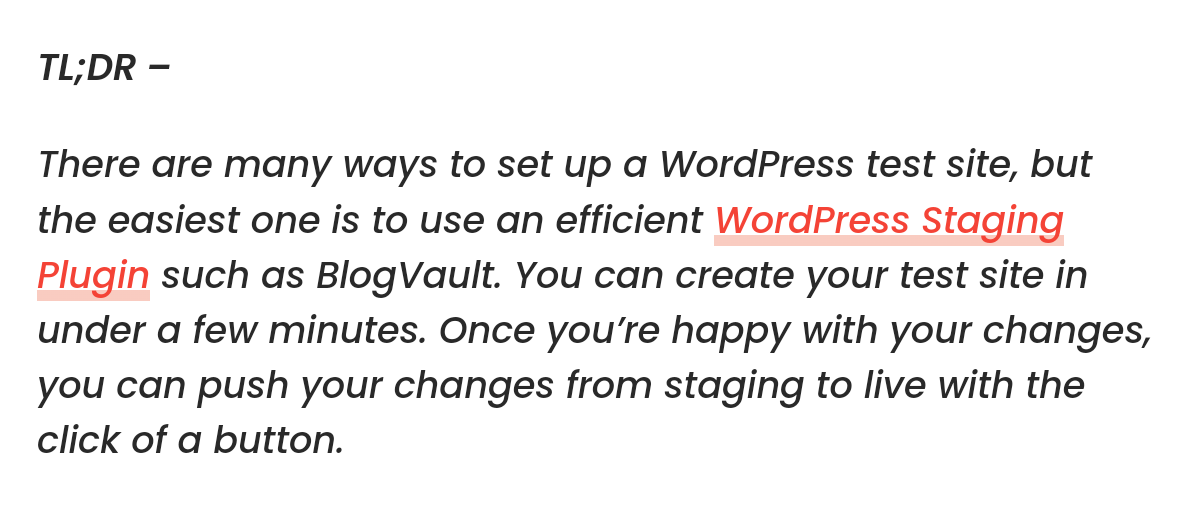
Image source: Blogvault
They feel once readers have the key takeaway, they’d walk away, not giving two f**ks about the brand.
Maybe.
Maybe not.
No straightforward answers here.
But before anything else, remember; people are BUSILY in need.
They’re reading your blog because they need answers.
If you can avoid the twists and turns and provide answers in the blink of an eye, please do.
The pristine appreciation you’d show to someone who’d help you in an instant is similar to what you’ll receive when readers realize they can count on you to cut the fluff.
💡Pro Tip: Don’t place your TL;DR sections after the meta dec—allow your audience a subtle glance at your intro.
5. Use an array of media format
I love words… so I can spend all day telling you how lucrative the right word can be.
But then again, there’s this truism about images speaking a thousand words.
Readers love a good read because a good read is illustrative.
Memes, infographics, GIFs, short videos, and screenshots are all arrays of media formats you can use to tap into emotions and make people click.
Still, don’t forget; each media format conveys emotions differently.
Memes are funny; short videos are descriptive.
Pro Tip: Learn the difference between each media format and the impact on readers before adopting. Sadly, not all images can hold a thousand words.😓
6. Make your content a joy to skim, and read
Some readers quit after reading a TL;DR. That’s alright. I understand they’re busy.
Some skim the content, exploring H2s and H3s before exiting. That’s also alright; they’ve got what they came for.
Then others read through, word for word. These people make B2B blogging worth doing; the real MVPs worth plowing the internet for.
The harsh truth: everyone on the above list is your audience.
So, at all times, regardless of whether they spend a minute or an hour exploring your content, you must never leave them hanging.
Here’re a few tips for the road:
- Lead with a table of content interlinked across relevant sections.
- Slice and dice quick facts and💡pro tips across content.
- Bold or italic key points sparingly.
- Place an extra white space after each header.
- Include the name of the editor, the date posted, and the date updated.
💡Pro Tips: Your website fonts reveal much about how readers approach and react to your blog. Don’t settle for Grandma’s best choice of font. If you’ve got the budget, split-test.
7. Insightful meta descriptions
150 to 155 characters is the industry standard for meta descriptions.
Meaning you have to summarize your B2B blogs using the alphabet less than 160 times for Google to index your content.
‘Well and good,’ You might say to yourself, ‘there’s generative AI, that’s no big deal.’
Not until you realize that it’s not just about indexing.
If these 155 characters are not insightful enough to leave readers craving more, organic search won’t move the needle for you.
💡Pro Tip: Stop using the first line of your blogs as meta desc. It makes your content repetitive, a red flag readers rarely ignore.
8. Link to related reads
A single blog can only tell as much as a 1000 to a 5000-word piece can hold—a gist of the story.
Indeed, readers also want the subplots and side talks, but in bits and pieces. That’s why they didn’t download a comprehensive guide.
To avoid scaring them with a lengthy read, include corresponding content.
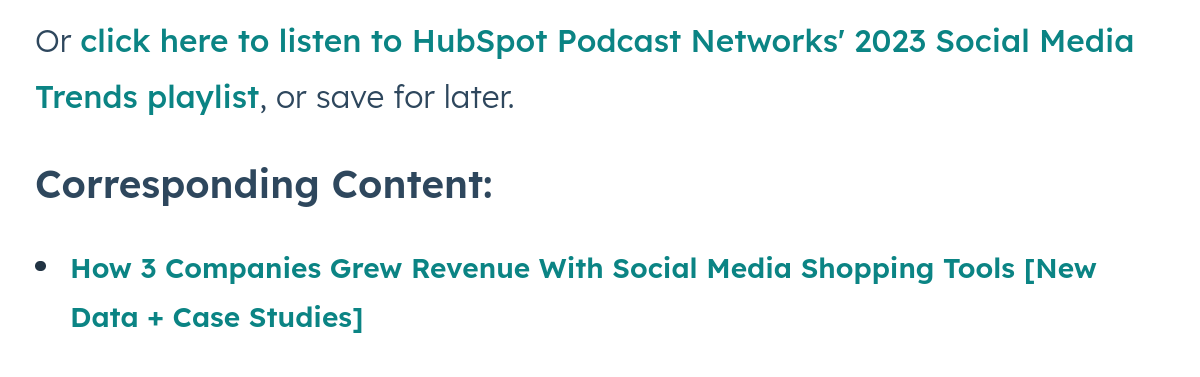
Image source: HubSpot
Simply hyperlink blogs related to your topic or customize a session of suggested reads.
💡Pro Tip: Do not hyperlink any text in your intro. It distracts readers and makes them hop off your blog slightly less than a few lines in.
9. Blend FAQs (frequently asked questions) and PPAs (people also asked questions) into content
Using FAQs or PPAs to inform consumers is an easy way to stay ahead of the game, especially if you’re in a new category.
Just don’t make the mistake of placing these questions in a section of their own.
Why’s that?
FAQs or PPAs, in a section of their own, reads like terms and conditions.
People rarely read such content. They prefer to click YES and pass.
Perfectly blending your FAQs or PPAs into blogs provides a warm feel.
Readers won’t ignore the content, and Google will index it for being thorough.
💡Pro Tips: YES, including FAQs on your website’s homepage is alright. Just don’t adopt the same mindset when optimizing your blogs.
Wrapping up
Cryptic drop-offs don’t always mean your B2B blog lacks depth or insight.
People gain and lose interest for unexplainable reasons.
Sometimes, a clickable link across sections inspires all the right actions; other times, an exaggerated bio at the top of your content makes everyone pissed.
Either way, when in doubt, have a conversion-based writer come through the door and chew down the bones.
Peace out!✌

- Software Comparison: The Definitive Guide - 28/12/2023
- Factual Vs. Opinion-based Software Reviews: Which Converts Best? - 11/10/2023
- Is Writesonic Any Good for SaaS Content Writers? - 09/10/2023